
Dearousal Skills
Use these skills to calm down after you lost your sh!t
Dearoual Skills
How to bring your system back down after you’ve already lost it
Sometimes you don’t catch it early.
You snap.
You shut down.
You say something sharp.
You walk out.
You melt down or blow up.
And then comes the part nobody teaches you: what to do next.
De-arousal skills are not crisis skills. They are not about stopping escalation in the moment. They are what you use after the peak has passed, when your nervous system is still running hot and you’re dealing with the fallout.
If you skip this phase, the system stays activated for hours or days. That’s how one incident turns into exhaustion, shame, withdrawal, or another blow-up later.
De-arousal skills help you:
-
bring adrenaline down
-
clear residual activation
-
shorten the emotional hangover
-
reduce rumination and replay
-
return to baseline faster
These skills matter because how you come down determines how long recovery takes.
When to use de-arousal skills
Use these skills when:
-
the argument is over but you’re still shaking
-
you’ve snapped or shut down and feel wrecked afterwards
-
your body feels wired, heavy, or flat
-
you’re replaying the event on loop
-
you feel embarrassed, ashamed, or depleted
-
you’re “off shift” emotionally but your system hasn’t stood down
This is not about punishment or fixing yourself.
It’s about resetting the nervous system after overload.
Tension Release Exercises (TRE)
Letting the body finish what it started
What it’s for
TRE is used when:
-
your body feels charged, shaky, or tight after an incident
-
you feel keyed up even though the situation is over
-
you can’t relax no matter what you tell yourself
-
you feel like the stress is stuck in your body
Frontline workers are very good at suppressing physical stress responses. TRE allows the body to discharge residual activation without needing to talk about the event.
Why it works
During escalation, your body prepares for action:
-
muscles tense
-
adrenaline surges
-
defensive responses activate
When the situation ends but those responses aren’t completed, the activation stays trapped. TRE uses controlled muscle fatigue to trigger natural neurogenic shaking, which helps the nervous system stand down.
This is not panic shaking.
This is a built-in biological reset mechanism.
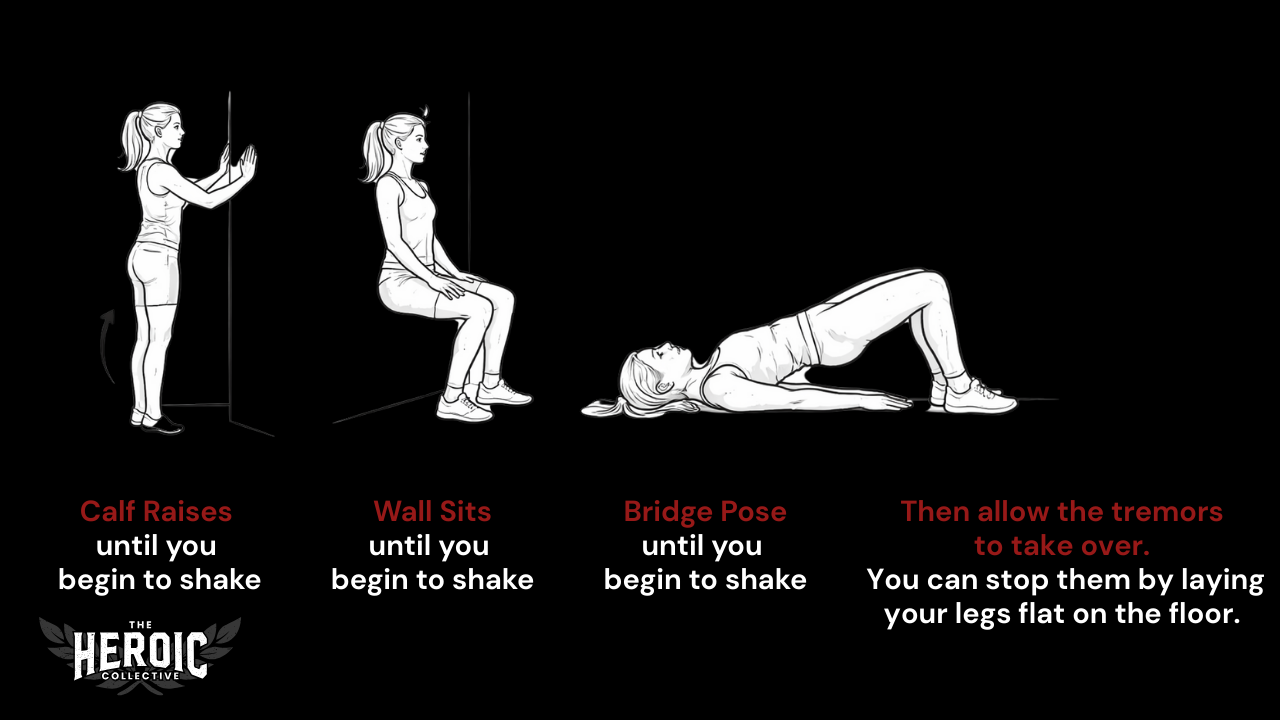
How to use TRE (brief overview)
TRE is usually learned once and then practised independently.
In simple terms:
-
you use specific positions to gently fatigue the legs
-
this activates involuntary shaking or trembling
-
you allow the shaking to happen without forcing or stopping it
-
sessions are short and controlled
You are not reliving anything.
You are not analysing anything.
You are letting the body do what it already knows how to do.
When TRE is most useful
-
after intense emotional or physical stress
-
after incidents involving threat, anger, or fear
-
when words don’t help
-
when your body won’t settle on its own
TRE is particularly effective for people who live in their bodies and struggle with traditional “talk it through” approaches.
Below we have added our favourite TRE demo. You can follow along with the girls

Graceful Exit
Leaving before you do more damage
What it’s for
Graceful Exit is for moments when:
-
you realise you’re escalating fast
-
you’re about to say something you can’t take back
-
the conversation has turned unproductive or hostile
-
staying will make things worse
This skill is not avoidance.
It is strategic withdrawal.
When to use Graceful Exit
Use this skill when:
-
your intensity is rising fast
-
you’re about to say something you can’t take back
-
your body is showing warning signs
-
the conversation has stopped being productive
Common signs:
-
clenched jaw
-
clenched fists
-
pacing
-
raised voice
-
tunnel vision
Once you’re here, insight won’t help.
Staying will escalate things further.
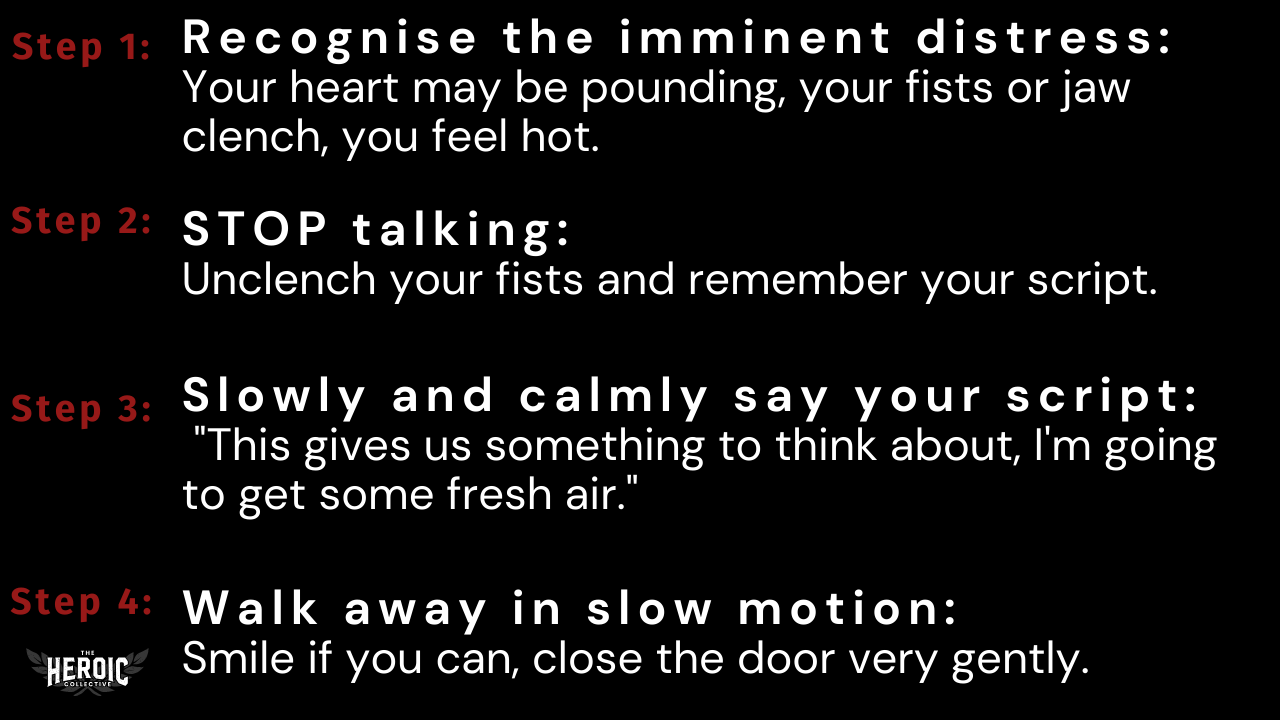
The structure of a Graceful Exit
A Graceful Exit has four parts.
1. Recognise what’s happening
You notice your internal warning signs:
-
heart pounding
-
muscle tension
-
heat rising
-
urge to attack or shut down
This is the moment you intervene.
2. Stop talking
This is critical.
Continuing to talk while escalated is how damage happens.
Silence is not weakness.
It is containment.
3. Use a prepared script
When distressed, you won’t find the right words on the spot.
That’s why scripts matter.
Examples:
-
“This gives us something to think about.”
-
“I need some time to consider this.”
-
“I’m going to get some fresh air.”
-
“Let’s pause and come back to this.”
If possible, add a return cue:
-
“I’ll be back in 15 minutes.”
-
“Let’s revisit this later.”
This communicates:
The conversation is stopping — the relationship is not.
4. Leave slowly
If you storm out, the message is escalation.
So deliberately move slower than feels natural:
-
stand up calmly
-
walk, don’t charge
-
avoid slamming doors
Even “slow” will still feel fast when activated — but it prevents additional damage.
Why Graceful Exit protects relationships
Many people have experienced:
-
arguments with a dramatic finale
-
someone walking out with no explanation
-
the panic of “is this over forever?”
Graceful Exit avoids that.
It ends the argument without ending the relationship.
When both people understand the skill, it becomes a mutual safety mechanism:
-
one person waves the white flag
-
the other respects it
-
escalation stops
That moment of restraint often prevents hours, days, or weeks of fallout.
A critical note
Graceful Exit works best when:
-
both parties understand what it means
-
the script has been discussed ahead of time
If the other person doesn’t know the skill, they may follow you, pursue the argument, or escalate further.
This is why we recommend:
-
explaining the skill to key people in your life
-
agreeing on scripts in advance
Grounding
Bringing yourself back to the here and now when your head has taken off
Grounding skills are about bringing your attention back to the present moment.
When frontline workers escalate, it’s rarely because of what’s happening right now. It’s usually because the mind has gone somewhere else:
-
catastrophising about what might happen next
-
replaying something that already happened
-
running threat scenarios on repeat
Grounding pulls you out of the past or future and back into this moment, where you actually have control.
If you have a tendency to shut down, space out, or dissociate, grounding is also about bringing yourself back into your body — here, now, safe.
These skills are subtle, portable, and can be used anywhere, including on shift.
5–4–3–2–1: Sensory grounding
This is one of the most reliable grounding tools because it uses non-triggering sensory input to anchor your attention.
Stop for a moment and name:
-
5 things you can see
-
4 things you can hear
-
3 things you can touch
-
2 things you can smell
-
1 thing you can taste
You don’t need to make it meaningful.
You’re not analysing. You’re just noticing.
It might be:
-
the desk
-
the floor
-
the sound of air conditioning
-
your boots
-
the taste of coffee from earlier
The purpose is not relaxation.
The purpose is orientation.
This pulls attention away from rumination and back to neutral, present-moment input.
Drop Anchor: grounding through the body
This is especially useful if:
-
you feel spaced out
-
you’ve just come out of dissociation
-
scanning the room feels overwhelming
Instead of looking around, you ground downward.
While seated:
-
push your feet firmly into the floor
-
imagine driving your heels down into the ground
-
notice the pressure coming back up through your legs
-
feel the chair supporting your weight
Silently remind yourself:
I’m here. I’m in this room. This moment is safe.
This works because pressure and weight are powerful signals of safety to the nervous system.
Counting and scanning
Pick something with a high frequency and start counting:
-
green objects
-
trees
-
cars
-
doors
-
bins
-
light fixtures
This can also be used with kids, partners, or teammates.
It works because it:
-
interrupts mental loops
-
directs attention externally
-
uses neutral, non-threatening stimuli
Grounding doesn’t need equipment.
It doesn’t need privacy.
It just needs attention redirected on purpose.


Crisis Skills
Learn how to manage panic when you have lost your sh!t
Sleep Skills
Get some sleep because nothing will improve until you do.
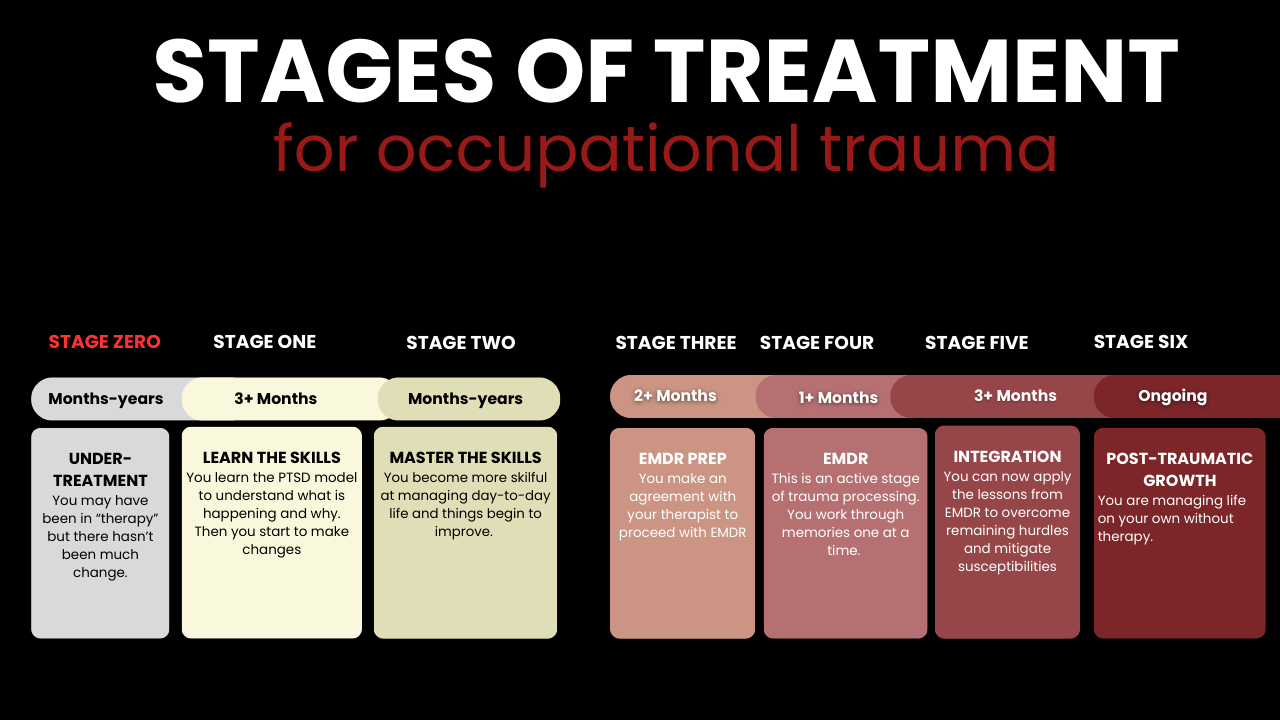
Stages of Treatment
Understand what the stages of treatment are so you can progress to post-traumatic growth