Sleep Skills 

Use these skills to quiet your mind so you can get to sleep

Jump to Set a Routine
Jump to Clear Your Head
Jump to Tactical Meds

Sleep Skills

How to protect sleep when trauma symptoms are active

Sleep is one of the first systems to take a hit when trauma symptoms start developing.

For many frontline workers, sleep problems don’t start at the point of burnout or collapse. They start years earlier:

  • taking longer to fall asleep (increased sleep latency)

  • waking around 2–3am from cortisol spikes

  • lighter, more fragmented sleep

  • early nightmares that gradually become more frequent

Nightmares are one of the strongest early indicators that PTSD is developing, and they are one of the most disruptive forces on sleep.

Sleep matters because when sleep deteriorates:

  • emotional regulation worsens

  • concentration drops

  • irritability increases

  • recovery slows

  • symptoms escalate faster

It’s important to be clear about expectations.

If you are early in PTSD treatment and have not yet done trauma processing, sleep may not fully normalise yet. That doesn’t mean there’s nothing you can do. It means the goal right now is to optimise sleep as much as possible while you work toward trauma processing.


Set a Routine

Teaching your nervous system when it’s safe to stand down

If you’re still working frontline, chances are you’ve done shift work. Shift work disrupts sleep because it destroys predictability. Your body can’t tell when the next opportunity for sleep is coming, and being forced to sleep during the day (especially with light exposure) works directly against your biology.

If you’re currently off work due to PTSD, this is an opportunity to rebuild a sleep routine that your nervous system can rely on.

The easiest way to understand this is through parenting.

Parents know that kids sleep better when:

  • dinner happens at roughly the same time

  • bath, teeth, stories and lights out follow a predictable pattern

  • the body starts preparing for sleep before the bed appears

Adults are no different.
We just forget that we need the same cues.


Step 1: Identify your chronotype

Everyone has a biological preference for sleep timing:

  • Morning types: naturally wake early and sleep earlier

  • Night types: prefer staying up later and sleeping in

This isn’t about discipline — it’s biology.

Where possible, work with your chronotype rather than against it when choosing a bedtime. Forcing yourself into a schedule your biology hates will always be harder.


Step 2: Work backwards one hour from bedtime

Once you’ve chosen a target bedtime, look at the hour before bed.

This hour is not about entertainment.
It’s about de-arousing the system.

This means:

  • turning screens off at least one hour before bed

  • reducing stimulation, not replacing it

Many people keep scrolling until the moment they turn the lights off because the moment screens stop, their thoughts flood in. That avoidance works briefly — but those thoughts then appear in bed, when you’re trying to sleep.

The goal is to address arousal before bed, not dodge it.


Step 3: Use deliberate wind-down activities

Once screens are off, choose activities that actively cue sleep:

Examples:

  • shower or bath

  • gentle stretching

  • calming music

  • changing into pyjamas

  • brushing teeth and skincare in a set order

These routines act as external signals to your brain that sleep is coming.


Step 4: Manage light exposure

Melatonin (the hormone that prepares you for sleep) is triggered by dimming light.

In the hour before bed:

  • switch to lamps or dimmable lighting

  • avoid bright overhead lights

  • make the environment as dim as you can safely manage

Light matters more than most people realise.


Step 5: Protect sleep associations

Your brain learns what “bed” is for.

If you use your bed for:

  • scrolling

  • reading

  • watching TV

  • worrying

your brain stops associating bed with sleep.

Key rules:

  • only use bed for sleep

  • read on the couch or a chair, not in bed

  • change out of pyjamas in the morning

  • don’t spend daytime hours in bed unless asleep

  • keep sleep items (pillows, blankets) in the bed, not around the house

Sleep associations are powerful. Protect them.


If your mind still buzzes in bed

If, despite doing all of the above, your brain switches on the moment you lie down, that’s a sign of unresolved mental arousal, not a routine problem.

That’s when you use the Clear Your Head Before Bed skill 


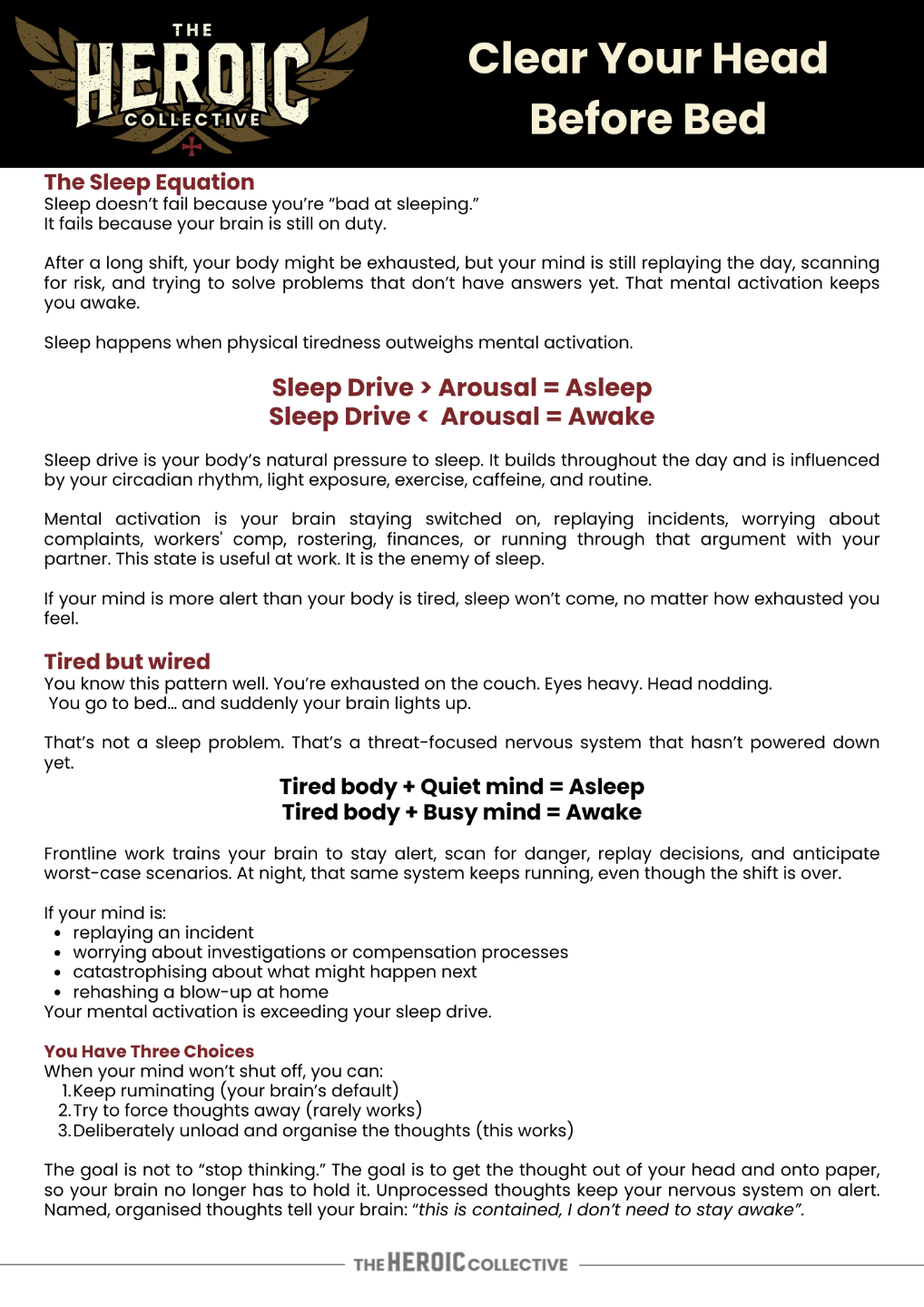
Clear Your Head Before Bed


How to shut your brain down so sleep can actually happen

For most frontline workers, sleep problems aren’t about being tired.

You’re exhausted.
Your body wants sleep.
But your brain won’t stand down.

You finally stop moving, the house goes quiet, you get into bed — and suddenly:

  • every unresolved issue pops up

  • conversations replay

  • future problems queue themselves up

  • your brain goes into threat-planning mode

This is not a lack of discipline or relaxation.

It’s arousal beating sleep drive.


The model you need to understand first

Sleep comes down to a simple equation:

Sleep drive vs arousal

  • Sleep drive is what builds up the longer you’re awake

  • Arousal is everything that keeps your brain and body switched on

If sleep drive is higher than arousal, you sleep.
If arousal is higher than sleep drive, you stay awake — no matter how tired you are.

For many frontline workers, mental arousal is the main problem.

Not noise.
Not caffeine.
Not screens.

Thoughts.

That’s what this skill targets.


Why your brain explodes at bedtime

During the day, you’re busy:

  • working

  • moving

  • responding

  • distracting

Your brain parks unresolved issues and says, “We’ll deal with this later.”

Bedtime is when “later” arrives.

The moment stimulation drops, those parked thoughts come flooding back.
If you wake during the night, the same thing happens.

So the goal of this skill is simple:

Get the thoughts out of your head before you try to sleep.


The Clear Your Head Before Bed skill

Step-by-step instructions

You can do this:

  • an hour or two before bed

  • earlier in the evening

  • or during the night if you wake up wired

The timing matters less than doing it deliberately.


Step 1: Sit down and let the thoughts surface

Sit somewhere quiet with:

  • a piece of paper or the handout

  • a pen

Close your eyes briefly and notice:

  • what keeps bubbling up

  • what your brain keeps circling

  • what feels unfinished or urgent

These thoughts will show up later if you don’t deal with them now.


Step 2: Write it out — don’t just think it

Thinking goes in circles.
Writing forces straight lines.

Write everything out in full:

  • worries

  • reminders

  • decisions

  • conversations

  • “don’t forget this” items

This isn’t about fixing anything yet.
It’s about dumping mental clutter out of your head and onto paper.

Once it’s written, your brain no longer has to hold it.

Step 3: State each issue concisely

After writing freely, go back and crystallise each issue into one clear sentence.

Think of it like turning a storm cloud into a labelled file.

Examples:

  • “I’m worried about how that meeting went.”

  • “I need to deal with the legal paperwork.”

  • “I’m concerned about money this month.”

If you have multiple issues, use:

  • one issue per page

  • or one issue per section

Just naming it clearly already reduces arousal.

Later, when the thought pops up in bed, you can say:

“That’s that issue.”

And move on.


Step 4: Decide — is this solvable or unsolvable?

Every problem falls into one of two categories.

Option A: This problem is unsolvable

Some things cannot be fixed right now:

  • past events

  • other people’s behaviour

  • uncertainty you can’t control

  • outcomes that haven’t happened yet

Write this clearly:

“This problem is unsolvable.”

Say it out loud if you can.

This matters. Hearing yourself say it helps your brain stand down from pointless effort.

When the thought comes back later, you can remind yourself:

“That’s the unsolvable one. I’ve already parked it.”


Option B: This problem is solvable

If something can be addressed, do not solve it in bed.

Your job here is not full problem-solving.
It’s reducing arousal so you can sleep.

Ask one question only:

What is the single next action?

Not the whole plan.
Not contingencies.
Not “if this happens, then that.”

Just the next concrete step.

Examples:

  • “Find a lawyer’s phone number.”

  • “Send one email.”

  • “Book an appointment.”

  • “Put this in my calendar.”


Step 5: Schedule the next action

This step is non-negotiable.

If you don’t schedule it:

  • your brain won’t trust that it’s handled

  • the thought will keep resurfacing

Put it:

  • in your diary

  • in your phone

  • in your task list

Be realistic about timing.

Once it’s scheduled, your brain can stop monitoring it.

That’s the point.

Watch the Video and download the Handout to put this skill into practice. 


Video Poster Image

Tactical Medication Use for Sleep

Avoiding dependence while getting enough rest to function

When sleep deprivation becomes severe, people get desperate. That’s understandable.

What we commonly see is:

  • increased alcohol use to “knock off the edge”

  • nightly reliance on sedating medications

  • chasing unconsciousness rather than restorative sleep

This often makes sleep worse, not better.


Alcohol is not a sleep aid

Alcohol interferes with the brain’s electrical activity during sleep. At higher doses it doesn’t produce sleep — it produces non-wakefulness.

As alcohol is metabolised:

  • people wake at 2–3am

  • arousal spikes

  • sleep fragments

  • fatigue worsens the next day

This is why people often feel more exhausted after drinking to sleep.


Sedating medications: use with caution

Some medications are commonly prescribed with instructions to take them every night. This approach carries real risks.

Two categories we are particularly cautious about:

Seroquel (Quetiapine)

  • Causes drowsiness by blocking histamine

  • Interferes with dopamine over time

  • Associated with cardiovascular deterioration

  • Makes accessing positive emotion harder

  • Often causes a 10–12 hour “hangover” effect

It can get people unconscious, but not necessarily rested.


Benzodiazepines (e.g. Temazepam, Valium)

  • Highly addictive

  • Cause rebound anxiety when they wear off

  • Encourage dose escalation

  • Temazepam lasts ~4 hours (leading to night waking)

  • Valium accumulates in the body with nightly use

These medications can quickly become part of the problem.


Dr Al’s rules for sleep medication

When medication is needed, it must be used strategically, not nightly by default.

Rule 1: Do not aim for medicated sleep every night
If sleep is poor seven nights a week, aim for:

  • 4 nights of medication-assisted sleep

  • 3 nights of natural sleep

This reduces dependence and tolerance.

Rule 2: Choose lower-risk options where possible
Dr Al prefers medications with:

  • lower side-effect profiles

  • less addiction risk

Examples may include:

  • antihistamines (e.g. Restavit, Phenergan)

  • clonidine (if blood pressure allows)

  • prazosin for nightmares (commonly used in PTSD)

Medication choice always depends on individual medical factors.

If you’re currently on nightly Seroquel or benzodiazepines

If you’re taking these:

  • more than four nights a week

  • or feeling increasingly dependent

We strongly recommend discussing alternative strategies and dosing with your treatment provider.


The bigger picture

Sleep optimisation can help you function — but trauma processing is what actually restores sleep long-term.

If you’re in treatment, talk to your therapist about:

  • where sleep fits in your recovery timeline

  • when trauma processing is likely to begin

  • what to expect as your nervous system recalibrates

Sleep improves most sustainably when the underlying trauma load is addressed.

Crisis Skills

Learn how to manage panic when you have lost your sh!t

Go to Crisis Skills

Dearousal Skills

Learn what to do after you lost your sh!t and now need to calm down.

Go to Dearousal Skills

Stages of Treatment 

Understand what the stages of treatment are so you can progress to post-traumatic growth

What are the Stages of Treatment?