Anger and Distress Skills 

These are the essential skills for managing PTSD

Jump to the Distress Cycle
Jump to Anger Autopsies
Jump to the SUDs scale

What is the Distress Cycle?

If you live with PTSD, anger can feel like it comes out of nowhere.

One minute you’re fine. The next, it’s like a switch flips. You say things you don’t mean. You see the damage on your partner’s face. Then the anger disappears… and you’re left picking up the pieces again.

That’s the low-resolution version of anger — “not angry” → “possessed by anger” → “regret.”

But anger doesn’t actually work like that.

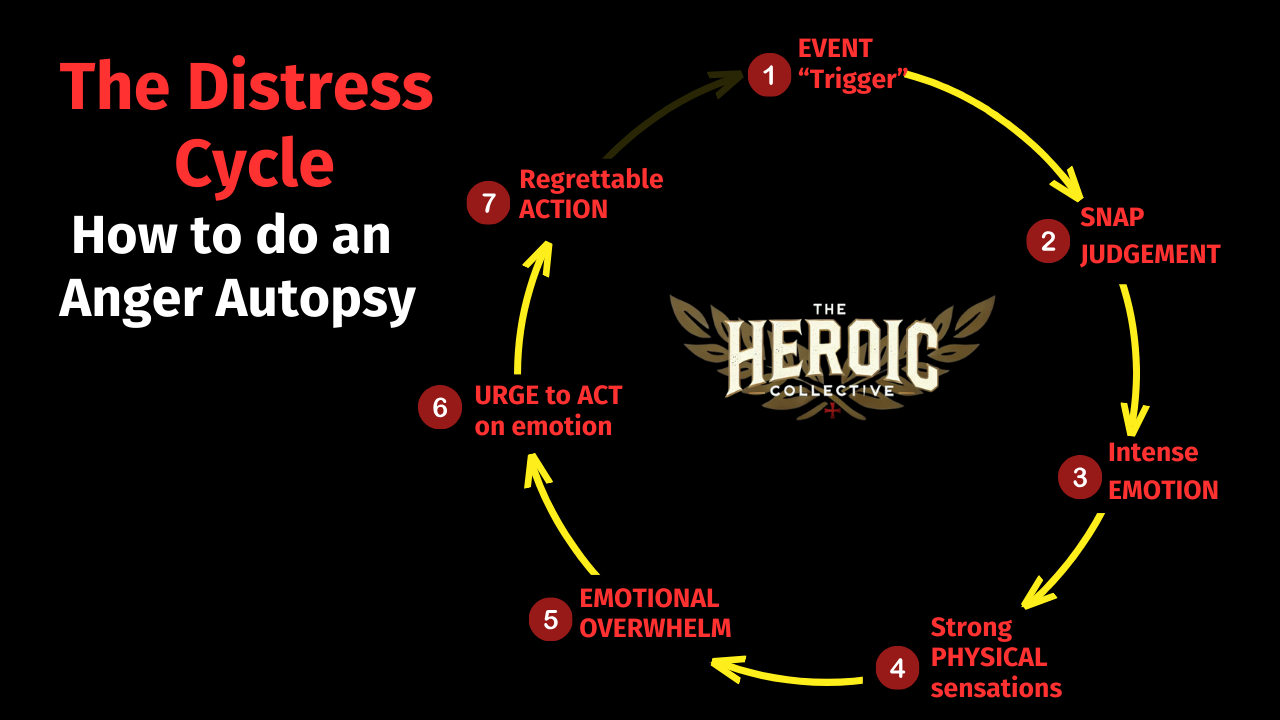
Under the surface, it follows a predictable seven-step distress cycle:

  1. The Event – What happened

  2. The Snap Judgment – The instant interpretation (“I’m being disrespected”)

  3. The Intense Emotion – Anger

  4. The Physical Activation – Heart pounding, heat, clenched jaw

  5. Emotional Overwhelm – Infuriation

  6. The Urge to Act – Attack, lash out, defend

  7. Regrettable Action – The damage that follows

When you don’t understand this cycle, it feels like zero warning.

But when you learn it in high resolution, something powerful happens:
You start to notice the physical sensations before the explosion.

That’s your anger warning light.

To help you learn how to manage your anger, we developed an online course called Rescue Your Relationships from PTSD Anger to teach you about the Distress Cycle.  and we teach you how to memorise, recognise, and interrupt the distress cycle — so you can stop the blow-ups before they rupture your relationship.

Because anger isn’t random.
It’s patterned.
And patterns can be changed.
Teach Me More

What is an Anger Autopsy?

Knowing the distress cycle is step one.
Installing the warning light is step two.

An anger autopsy is how you wire it in.

After an anger episode — once the dust settles — you walk back through the seven steps and map out exactly what happened:

  • What was the real event?

  • What snap judgment did I make?

  • What did I feel in my body?

  • How intense was it?

  • What urge did I act on?

  • What were the consequences?

  • What could I do differently next time?

It’s not about shaming yourself.

It’s about building awareness.

When you repeatedly track your physical sensations — the heat, the tight jaw, the pounding heart — your body becomes your early warning system. Over time, those sensations trigger an “aha” moment instead of an explosion.

Instead of:
Anger → Infuriation → Regret

You get:
Anger → Warning Light → Pause → Skillful Action

That pause is what saves relationships.

Inside Rescue Your Relationships from PTSD Anger, we walk you through the distress cycle step-by-step, give you structured anger autopsy templates, and show you exactly how to turn awareness into mastery.

This isn’t theory.
It’s practical, repeatable training.

Because your relationship deserves more than apologies after the fact.
It deserves a system that works before the damage is done.

 
Learn More about the Course

What Are SUDS — And Why Do They Matter?

SUDS stands for Subjective Units of Distress.

It’s a simple 1–10 scale that measures how distressed or “edgy” you are in the moment.

  • 1–3 = calm, relaxed, steady

  • 4–6 = alert, a bit tense, getting on edge

  • 7–8 = worked up, highly activated

  • 9–10 = overwhelmed, on the brink of losing it

SUDS gives you neutral, non-judgmental language to describe what’s happening internally — instead of saying “I lost it” or “I’m being ridiculous.”

Why is that useful?

Because anger rarely feels gradual. It feels like a hair trigger. By the time you realise how angry you are, you’re already halfway to a regrettable action.

SUDS forces a pause.

When someone asks, “Where are your SUDS at?” you have to reflect.
You become conscious of your internal state instead of being driven by it.

It also gives your partner vital information. If your SUDS are at an eight, they now understand you’re on edge. That awareness promotes empathy, reduces resentment, and allows both of you to respond differently.

SUDS isn’t just a number.
It’s an early warning system.

Inside Rescue Your Relationships from PTSD Anger, we show you exactly how to use SUDS (alongside other shared language tools) to create collaborative check-ins, prevent escalation, and build a united front against anger.

Because when both of you understand the signals, you stop fighting each other — and start managing the anger together.

I Want to Learn More

Crisis Skills

Learn how to manage panic when you have lost your sh!t

Go to Crisis Skills

Dearousal Skills

Learn what to do after you lost your sh!t and now need to calm down.

Go to Dearousal Skills

Rescue Your Relationships

Check out our online course to learn skills to save your relationships

Go to Course