
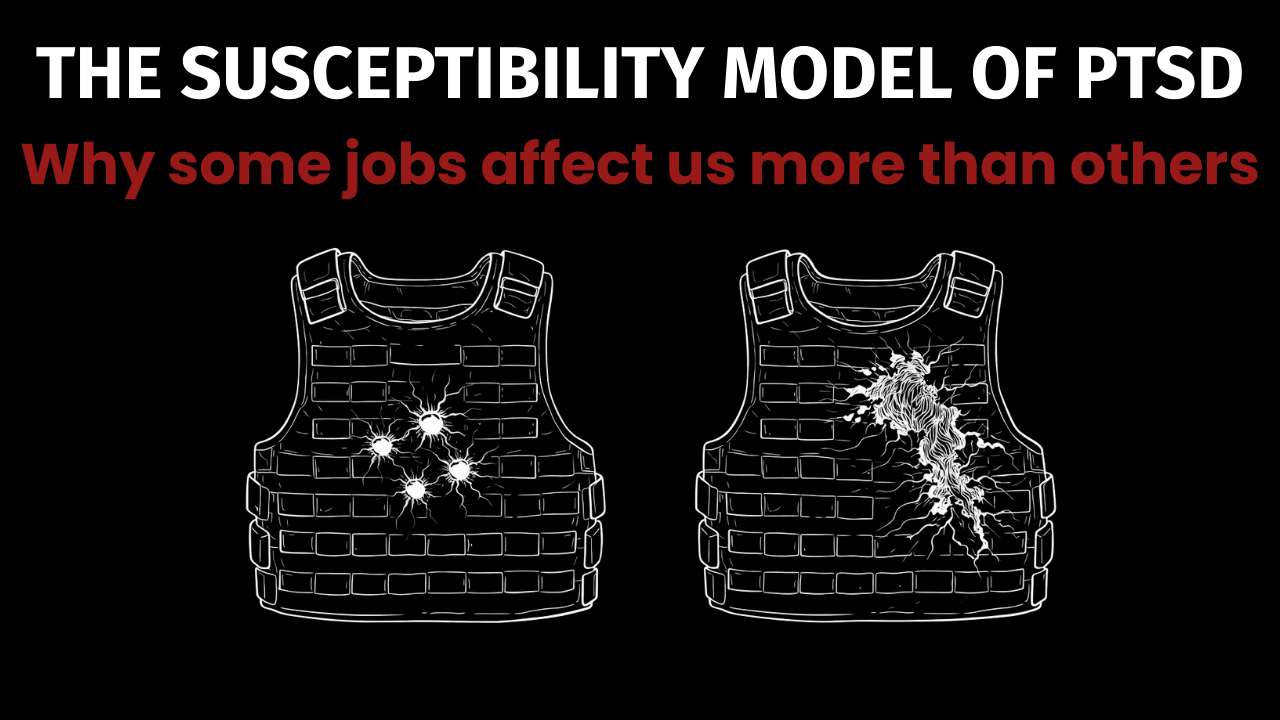
Why trauma gets you where you are vulnerable
When we talk about occupational PTSD — particularly in frontline workers — we often jump straight to symptoms.
Hypervigilance.
Nightmares.
Irritability.
Anger.
But before we talk about symptoms, we need to talk about something more fundamental:
Susceptibility.
Because trauma does not land randomly.
It gets you where you are susceptible.
Achilles and the Psychology of Vulnerability
Think about the Greek legend of Achilles.
Achilles was invulnerable everywhere — except for his heel. When he was a baby, his mother dipped him into the River Styx, holding him by the heel. That made him invulnerable, except for the part she was holding.
That one small area of susceptibility eventually got hit by an arrow.
That’s the idea.
No one is invulnerable everywhere.
Everyone has a heel.
In psychology, we call that a susceptibility.
And trauma doesn’t just “cause PTSD” in a vacuum.
It interacts with the heel.
We All Have Multiple Susceptibilities
One of the most important things to understand is this:
We’ve all got multiple susceptibilities.
And they manifest differently in different people.
Let’s take a simple example.
Imagine two frontline workers attending the same tragic scene.
One is highly empathic. They feel people’s feelings deeply. They absorb the emotional tone of a room. They are naturally attuned to suffering.
The other is more callous — emotionally detached, perhaps even hardened.
Who is more susceptible to vicarious trauma?
The empathic one.
Empathy, in that context, is a susceptibility.
Now that sounds almost counterintuitive. Empathy is a strength. It makes someone caring. It makes someone good at their job. It makes them human.
But it also means tragedy stirs them up more deeply.
The callous person may attend the same tragedy and think,
“Well, idiot had it coming.”
It doesn’t land.
Callousness, in that scenario, is protective.
The point is not that empathy is bad.
The point is that every personality trait carries both strength and vulnerability.
Empathy can be a strength in relationships.
It can also be a susceptibility in trauma-heavy professions.
That’s the core idea of the susceptibility model.
Trauma Gets You Where You Are Susceptible
Trauma does not operate in isolation. It does not simply “happen” and produce the same outcome in everyone.
It hits the heel.
If your susceptibility is empathy, trauma hits there.
If your susceptibility is fear of being judged, trauma hits there.
If your susceptibility is feeling replaceable, not good enough, not safe — trauma hits there.
That’s why two people can experience the same event and walk away differently.
It’s not about toughness.
It’s not about weakness.
It’s about where the arrow lands.
This is especially important in occupational PTSD.
Frontline workers are not randomly breaking down.
They are repeatedly exposed to experiences that interact with their unique psychological susceptibilities.
Developmental Trauma and the Formation of Susceptibilities
To understand susceptibility fully, we need to go back to childhood.
There’s a term that gets used a lot — “complex PTSD.” It’s a messy label. A more useful way to think about it is developmental trauma.
Developmental trauma occurs when something traumatic happens in childhood while your personality is still forming.
When that happens, it can deeply affect your outlook on the world.
In schema therapy language, it shapes the schemas you develop.
For example:
-
“I don’t matter.”
-
“I’m unsafe.”
-
“I’m going to be abandoned.”
-
“I’m not good enough.”
-
“People can’t be trusted.”
Those beliefs aren’t conscious decisions. They are adaptations.
And they become susceptibilities.
If you grew up feeling unfairly judged, your susceptibility might be sensitivity to criticism.
If you grew up feeling unsafe, your susceptibility might be hypervigilance.
If you grew up feeling emotionally neglected, your susceptibility might be intense fear of disconnection.
When occupational trauma occurs later in life, it doesn’t land on a blank slate. It lands on a personality that has already been shaped.
The arrow lands on the heel that was formed years earlier.
Single Incident Trauma: The Arrow That Nails the Heel
Now let’s move into adulthood.
Single incident trauma is easier to conceptualise.
A common civilian example would be a severe motor vehicle accident.
Before the accident, you cognitively understand that cars are dangerous.
After surviving a catastrophic crash — especially one involving injury or death — you don’t just “know” cars are dangerous.
You embody it.
Every time you get into a vehicle, your body reacts.
Your susceptibility has been nailed.
The foot with the arrow represents that heel being directly hit.
In occupational settings, this could be:
-
A particularly horrific call
-
A line-of-duty death
-
A situation where you felt helpless
-
A moment that directly challenged your identity
When trauma hits your personal susceptibility, it can set up post-traumatic stress.
But here’s where it becomes more relevant to frontline workers:
Most occupational PTSD is not about one arrow.
It’s about cumulative trauma.
Cumulative Trauma: Repeated Hits to the Same Heel
Cumulative trauma is the most common presentation in occupational PTSD.
It’s not one catastrophic incident.
It’s repeated exposure.
Imagine that same heel — the same susceptibility.
Early on, trauma lands, but your resilience holds.
You have what we might call a dam wall of resilience.
The trauma builds up behind it. There’s pressure. But you’re still functioning. You’re still able to automatically regulate your emotions.
You’re cracking on.
You might have some post-traumatic stress — fatigue, irritability — but not full-blown PTSD.
But then another arrow lands.
And another.
The trauma load builds.
Your resilience erodes.
Your susceptibility doesn’t change — but your capacity to buffer it does.
Eventually, the dam wall weakens enough that automatic emotional control starts to fail.
That’s when post-traumatic stress becomes post-traumatic stress disorder.
But the key mechanism is still the same:
Trauma repeatedly landing on a susceptibility.
Susceptibility Is Not the Same as Fragility
It’s important to be clear here.
Susceptibility is not fragility.
It is not weakness.
In fact, many susceptibilities are strengths in the right context.
Empathy is a strength.
Loyalty is a strength.
High responsibility is a strength.
Conscientiousness is a strength.
But when repeatedly exposed to trauma, those same strengths can become pressure points.
A highly responsible person may feel deep guilt about outcomes beyond their control.
A highly loyal person may struggle intensely with perceived betrayal.
A deeply empathic person may carry the emotional weight of every victim.
The same trait that makes someone excellent at their job can also make them more vulnerable to cumulative trauma.
That’s the paradox.
Why This Matters for Occupational PTSD
If you don’t understand susceptibility, PTSD feels random.
You might ask:
“Why me?”
“Why am I reacting like this when others aren’t?”
“What’s wrong with me?”
But once you understand the susceptibility model, the narrative shifts.
It’s not that trauma randomly damaged you.
It’s that repeated trauma interacted with your specific vulnerabilities.
And those vulnerabilities are often linked to the very qualities that made you good at your role.
In frontline professions, we often recruit for:
-
Empathy
-
Courage
-
Commitment
-
Emotional attunement
-
Sense of duty
These are strengths.
But they are also potential heels.
The Susceptibility Model Reduces Shame
One of the most powerful aspects of the susceptibility model is that it reduces shame.
If trauma simply “broke” you, that can feel humiliating.
But if trauma repeatedly struck at a known psychological vulnerability, that is understandable.
Everyone has a heel.
The goal is not to eliminate susceptibility. That’s impossible.
The goal is to understand it.
When you understand where your heel is, you can:
-
Recognise when it’s being hit
-
Understand why certain situations stir you up more than others
-
Stop personalising the reaction
-
Begin targeted recovery
Susceptibility Explains Variation in Symptoms
The susceptibility model also explains why PTSD doesn’t look the same in everyone.
Some people develop panic.
Some develop anger.
Some become emotionally numb.
Some withdraw.
Why?
Because trauma interacts with different susceptibilities.
If your heel is fear-based, trauma may amplify terror and hypervigilance.
If your heel is related to injustice or disrespect, trauma may amplify anger.
If your heel is related to abandonment or connection, trauma may amplify relational distress.
The core process is the same.
The expression differs.
The Foundation of Treatment
Before you can effectively treat occupational PTSD, you need to understand:
Where is the heel?
What are the susceptibilities?
Are they rooted in empathy?
In developmental trauma?
In core schemas about safety, worth, or belonging?
Without that understanding, treatment becomes symptom management.
With that understanding, treatment becomes targeted.
You are no longer just trying to suppress anger or reduce panic.
You are working on the underlying vulnerability that trauma has repeatedly struck.
The Big Picture
PTSD is not random.
Trauma does not hit everyone the same way.
We all have susceptibilities.
We all have heels.
In occupational PTSD, cumulative trauma repeatedly lands on those susceptibilities until resilience erodes.
Understanding this model changes the conversation.
It shifts it from:
“What’s wrong with me?”
To:
“Where am I susceptible — and how has trauma been interacting with that?”
That is the starting point.
Because once you understand susceptibility,
you stop seeing PTSD as a mysterious malfunction —
and start seeing it as a predictable interaction between trauma and vulnerability.
And predictable processes can be understood.
Understood processes can be treated.
Stay connected with news and updates!
Join our mailing list to receive the latest news and updates from our team.
Don't worry, your information will not be shared.
We hate SPAM. We will never sell your information, for any reason.