
Scheduling Skills
Use these skills to make a gentle plan for each day
Why do you need a schedule?
How structure fixes fatigue, morale and sleep
When PTSD takes over, routine disappears.
At work, you had structure. You had a start time, a finish time, defined roles and clear expectations. That routine quietly held your life together. It absorbed chaos.
Now imagine that structure is gone.
You wake up whenever. Coffee. Scroll your phone. Maybe get the kids off to school. A bit of washing. Lunch prep. Clean up. It’s 2pm.
How productive were you?
How’s your morale?
When you look back on your week, how do you feel about what you’ve actually achieved?
Ready to Try Something Different?
Order Your Chaos
What Is the Four Buckets Technique — and How Does It Work?
The Four Buckets technique is a way of taking everything swirling around in your head and putting it somewhere concrete.
When PTSD hits, life feels chaotic. Sleep is off. Energy is low. Your mind is busy but your days feel unproductive. You might sit down to “get organised” and end up with a list of 100 things to do — which only makes the chaos worse.
The Four Buckets solves that problem by assiting you to Empty Your Head Into Buckets
Start with a blank piece of paper and divide it into quarters. Label each quarter with:
- To Do Now
- To Do Later
- Projects and Big Tasks
- Junk
Then set a timer for 5 minutes and sit with your eyes closed. Think about what is on your mind. When a thought or idea bubbles up, write it in the corresponding box. Close your eyes and go again. Keep going until the timer goes off.
This gets the chaos out of your head and onto paper.
But here’s the important part:
The Four Buckets is not just a brain dump exercise.
It’s a system for implementation.
Because if you stop there, you’re left staring at 100 tasks and feeling worse.
Plan Your Projects
Breaking Big Tasks Into Manageable Pieces
Once you’ve emptied your head into the Four Buckets and imposed structure on your day, the next step is to turn overwhelm into progress.
Most people don’t avoid tasks because they’re lazy.
They avoid them because they’re too big.
“Fix my health.”
“Sort my finances.”
“Work on my PTSD.”
“Get my life back on track.”
Those aren’t tasks — they’re mountains.
The Four Buckets helps you turn mountains into stepping stones.
Step One: Identify Your Active Projects
Inside your buckets, you’ll notice certain themes emerging. These are your projects.
In PTSD recovery, three projects are compulsory:
-
Self-care
-
Becoming a PTSD expert
-
Becoming a PTSD skills ninja
If these don’t move forward, treatment stalls. You stay stranded.
But “self-care” is not a task. It’s a category.
So we break it down.
Step Two: Slice Projects Into Small, Doable Actions
Instead of:
-
“Get fit” → 20-minute walk
-
“Improve relationship” → Do one SUDS check-in
-
“Work on PTSD” → Watch one lesson
-
“Learn skills” → Practice one distress tolerance tool
-
“Rest more” → Schedule 30-minute recharge
The rule is simple:
If it feels heavy, it’s too big.
Shrink it until it feels doable.
You are not trying to win the war in one day.
You are trying to move the needle consistently.
Structure Your Day
Use the Two-Shift System
Divide your day into two clear work blocks:
-
Morning shift
-
Afternoon shift
If you’re a morning person, protect your evenings — they’re off duty. No guilt.
Each shift gets:
-
No more than three tasks
-
A mix of life admin and recovery projects
-
Clear start and finish boundaries
When the shift is done, you’re done.
You move from drifting… to completing.
Give Each Day a Theme
To create rhythm across the week, give each day a general focus. For example:
-
Monday – Reset & Self-Care
-
Tuesday – Admin & Life Tasks
-
Wednesday – PTSD Skills
-
Thursday – Appointments
-
Friday – Physical Health
-
Weekend – Family & Recharge
You decide what your week looks like — but it must look like something.
Clustering appointments into one day (where possible) prevents your entire week from being fragmented by single commitments.
Rest can be scheduled.
Recharge can be a project.
Recovery must be intentional.
What Structure Actually Gives You
-
A sense of achievement
-
Visible progress
-
Improved morale
-
Reduced chaos
-
Better sleep pressure
-
Less wasted time
Most people know what to do.
The problem is implementation.
Turn the Four Buckets into a working weekly structure — so your days stop disappearing and start building momentum again.

Crisis Skills
Learn how to manage panic when you have lost your sh!t

Dearousal Skills
Learn what to do after you lost your sh!t and now need to calm down.
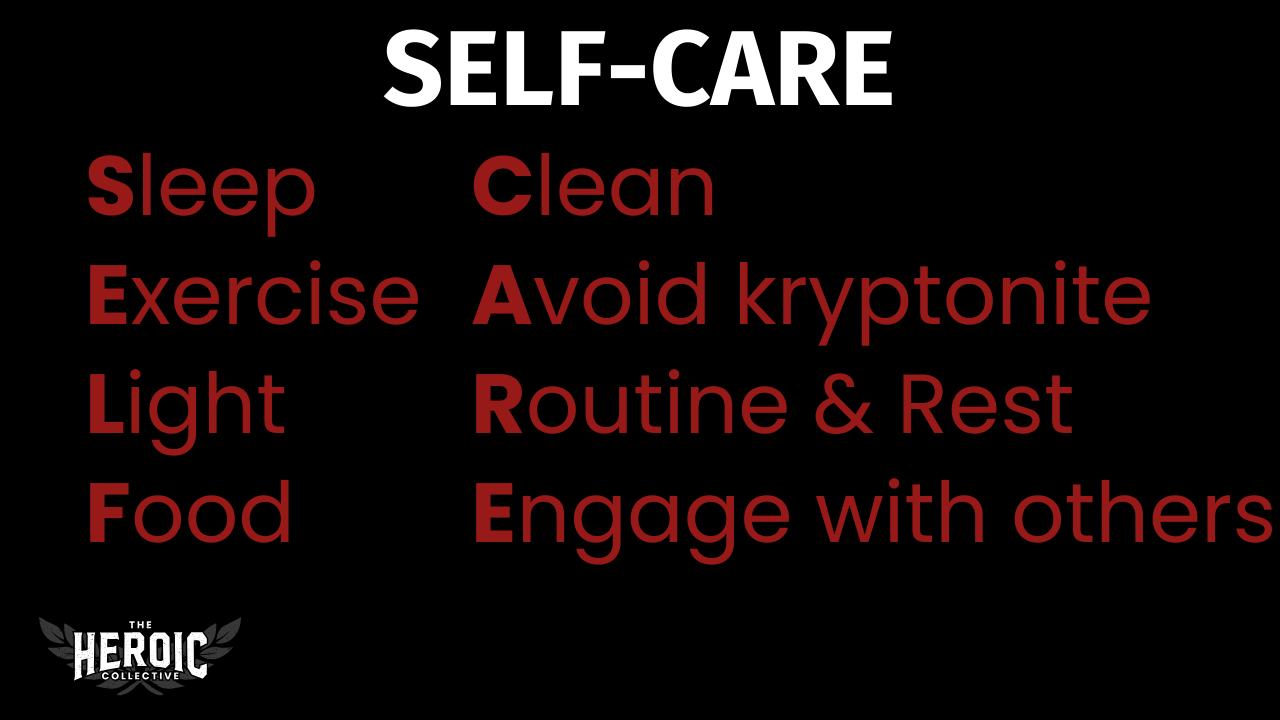
Self-Care Skills
Looking after your body will improve your fatigue so you can do your projects.