PTSD or Post-Traumatic Strain (PTS)? Why Emotional Suppression Failure Eventually Breaks Frontline Workers
Jun 18, 2026
PTSD or Post-Traumatic Strain (PTS)?
Why Emotional Suppression Failure Eventually Breaks Frontline Workers
Most people think PTSD appears suddenly.
Like a switch flipping.
One terrible trauma.
One catastrophic incident.
Then suddenly the person appears psychologically broken.
But for many frontline workers, especially police officers, military personnel, veterans, paramedics, firefighters, correctional officers, nurses, emergency workers, and first responders, the process is often much slower than that.
It is often cumulative.
A gradual wearing down of the emotional suppression system under chronic operational strain.
PTSD or Post-Traumatic Strain (PTS)?
So what is the difference between PTSD and Post-Traumatic Strain (PTS)?
In reality, they are closely related.
PTSD is a formal psychiatric diagnosis.
Post-Traumatic Strain (PTS) is a broader way of understanding the gradual nervous system deterioration that often occurs before full PTSD decompensation develops.
Many frontline workers spend years moving through Bravo, Charlie, Delta, and even Critical Delta before they are ever formally diagnosed with PTSD.
In other words:
PTS (strain) often precedes PTSD (disorder).
PTS describes the gradual wearing down of the emotional suppression system under cumulative operational strain.
PTSD often represents the later stage where emotional containment has substantially failed and the person has entered a more severe state of decompensation, "Stage Echo".
This is one reason many frontline workers say:
“I wasn’t suddenly traumatised overnight. I slowly fell apart over years.”
The framework is not attempting to replace PTSD.
Rather, it attempts to describe the progression that often occurs before and around PTSD.
Why Do Police, Military, and Frontline Workers Change Over Time?
One of the biggest misconceptions about PTSD in police, military, veterans, and emergency workers is that it always appears suddenly after one horrific event.
But for many people, the deterioration is gradual.
Operational stress slowly strains the nervous system over years, then the dam wall breaks.
This often leads to increasing emotional suppression exhaustion, irritability, hypervigilance, anger, emotional fatigue, and eventually emotional overflow.
Emotional Suppression Is Normally Invisible
Most people do not realise they are suppressing emotions all day long.
Because when the system is working properly, emotional suppression feels effortless.
A useful example is this.
Remember when you were six years old, having a whale of a time running around the lounge room?
Then suddenly:
BANG.
You stub your toe.
And instantly it feels like the world is ending.
Profound emotions surge up.
Pain.
Fear.
Distress.
Crying.
Screaming.
Help-seeking.
The emotional system completely overwhelms the child.
But when you are twenty-five years old and stub your toe, usually a simple:
“Fuck.”
gets the job done.
Why?
Because the adult emotional suppression system can effortlessly contain emotions that completely overwhelmed the six-year-old version of you.
Most of the time we barely even notice this system exists.
But frontline work places enormous strain on it.
Stress.
Responsibility.
Moral injury.
Cumulative pressure.
Traumatic events.
Sleep disruption.
Operational exposure.
Increasing baseline hypervigilance.
Effortful emotional suppression.
Over time the emotional suppression system starts becoming strained and exhausted.
As that happens, emotional overflow becomes increasingly common.
A little bit like the six-year-old version of you who became emotionally overwhelmed by stubbing their toe.
Now increasingly small irritations can suddenly trigger disproportionate emotional reactions:
- emotional overwhelm
- getting choked up easily, fighting tears
- irritability and verbal attacks
- anxiety
- situational panic
- road rage
- emotional shutdown
- emotional collapse
This process of emotional suppression failure is what The Heroic Collective refer to as Post-Traumatic Strain (PTS).
Importantly, Post-Traumatic Strain is not simply about trauma exposure itself.
It is about what chronic trauma exposure, operational strain, hypervigilance, unresolved emotional material, and cumulative stress gradually do to the nervous system’s ability to contain emotional overwhelm.
The Post-Traumatic Strain Continuum
The Post-Traumatic Strain Continuum attempts to explain how cumulative operational stress gradually changes frontline workers over time.
This framework is particularly relevant to:
- police PTSD
- military PTSD
- veteran PTSD
- paramedic burnout
- first responder trauma
- chronic operational stress
- emotional exhaustion in frontline workers
- PTSD anger and irritability
Many people reading this framework immediately recognise themselves somewhere on the continuum.
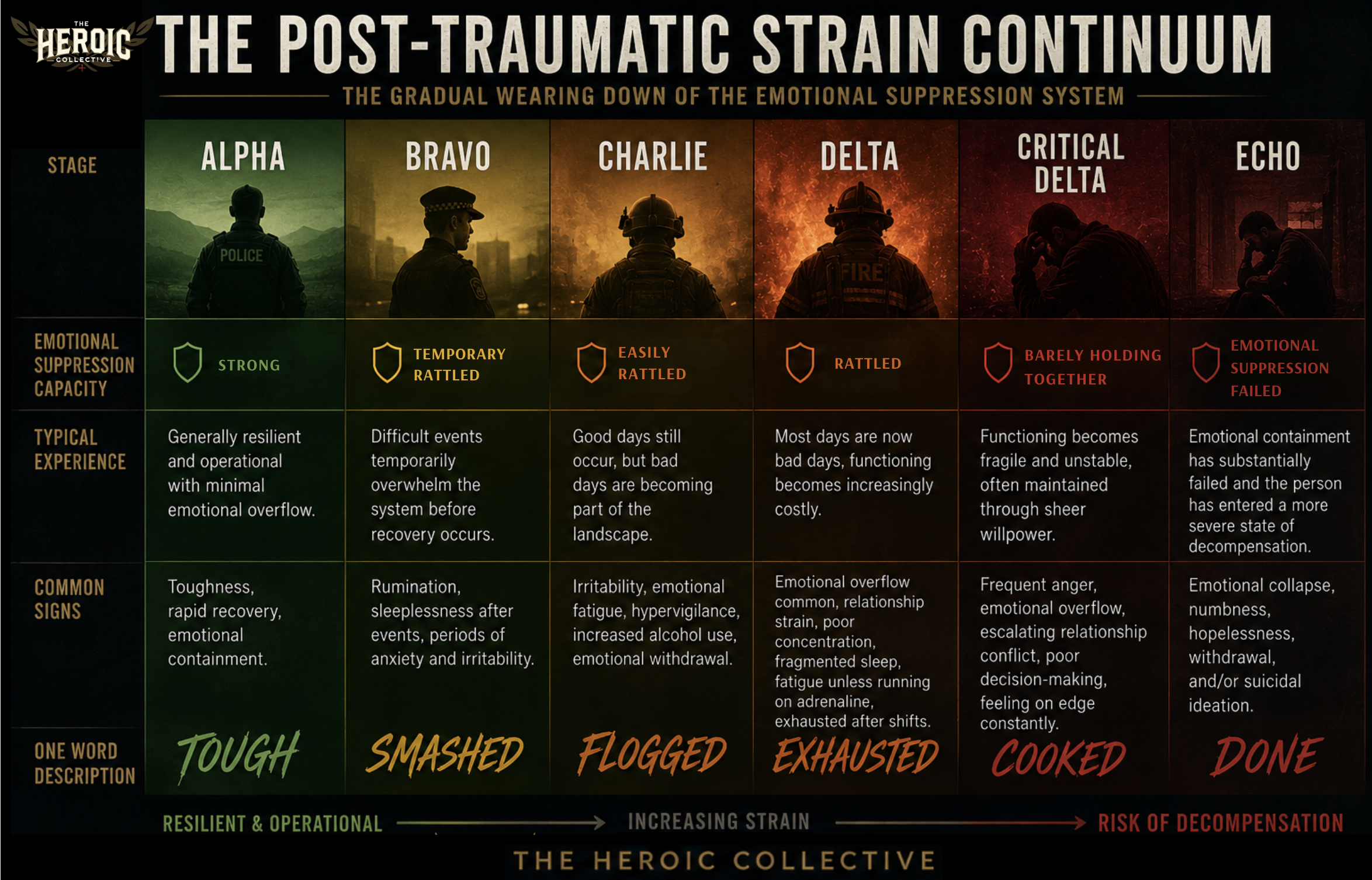
|
Stage |
Emotional Suppression Capacity |
Typical Experience |
Common Signs |
|
Alpha |
Strong |
Generally resilient and operational with minimal emotional overflow |
Toughness, rapid recovery, emotional containment. "Tough" |
|
Bravo |
Temporary strained |
Difficult events temporarily overwhelm the system before recovery occurs |
Rumination, sleeplessness after events, periods of anxiety and irritability. “Smashed by that job.” |
|
Charlie |
Moderately strained |
Good days still occur, but bad days are becoming part of the landscape |
Irritability, emotional fatigue, hypervigilance, increased alcohol use, emotional withdrawal. “Flogged.” |
|
Delta |
Severely strained |
Most days are now bad days, functioning becomes increasingly costly |
Emotional overflow common, relationship strain, poor concentration, fragmented sleep, fatigue unless running on adrenaline, exhausted after shifts. “Exhausted.” |
|
Critical Delta |
Barely holding together |
Functioning becomes fragile and unstable, often maintained through sheer willpower |
Frequent anger, emotional overflow, escalating relationship damage, severe fatigue, increasing mistakes, exhaustion after shifts. “Cooked.” |
|
Echo |
Failing / decompensated |
Emotional containment becomes unreliable and operational functioning collapses |
Rage, panic, emotional overflow, severe hypervigilance, inability to function. “Done.” |
One important thing to understand is that this continuum is not simply about “stress.”
It is specifically about the progressive failure of emotional suppression capacity under cumulative operational load.
As suppression capacity declines, emotional overflow becomes increasingly common.
That emotional overflow may appear as:
- irritability
- anger
- panic
- emotional collapse
- crying
- rage
- withdrawal
- shutdown
- emotional exhaustion
Importantly, people often fluctuate between stages.
Someone may operate at Charlie most of the year but temporarily deteriorate into Delta during periods of sustained overload, relationship conflict, sleep deprivation, organisational stress, or trauma activation.
What Stage Of Post-Traumatic Strain Am I In?
Many frontline workers ask:
- “Why am I becoming more angry and irritable?”
- “Why can’t I switch off anymore?”
- “Why do I feel emotionally exhausted all the time?”
- “Why am I becoming emotionally numb or reactive?”
- “Why does work feel different now?”
The stages below attempt to describe that progression.
Stage Alpha
Negligible Emotional Overflow In Most Situations
("Tough")
At Alpha, emotional suppression capacity is strong.
The person can generally experience stress, trauma, pressure, and adversity without significant emotional overflow.
This is often what people refer to as being “tough.”
But toughness is not magic.
Usually it is a combination of:
- low baseline emotional sensitivity
- high innate emotional suppression capacity
- good recovery
- strong nervous system reserve
It's easier to stay tough if one has low empathy, "flexible" ethics and can easily say "no".
It's hard to stay tough if one is empathic, highly ethical and agreeable.
At Strain Stage Alpha, difficult experiences may still lay down unresolved trauma material or “trauma land mines,” but the person often does not even notice.
Importantly, these land mines can still detonate years later under sufficient strain. This becomes increasingly common in stages Delta and Echo.
Stage Bravo
Early Compromise Of The Emotional Suppression System
At Bravo, the emotional suppression system has started becoming strained.
This may occur because of:
- high workload
- leadership issues
- chronic stress
- repeated trauma exposure
- sleep disruption
- sustained hypervigilance
- relationship strain
- unresolved traumatic experiences
At this stage, difficult operational events can lead to periods of emotional overwhelm.
For example:
- anxiety
- rumination
- sleeplessness
- preoccupation with work
- anger hangover
- emotional exhaustion
These symptoms may persist for several days after a difficult event, "smashed by a job".
Eventually the system appears to recover.
The person regains functioning.
And usually they simply “crack on.”
But if a trauma event led to the overwhelm, that often represents the laying down of a trauma land mine.
A trauma land mine may not detonate immediately.
It may go off months or years later when sufficient cumulative strain has accumulated.
Stage Charlie
Good Days With Increasingly Frequent Bad Days
At Charlie, most days are still “good days.”
But bad days are becoming part of the landscape.
Irritability becomes more common.
Recovery becomes less reliable.
The nervous system feels increasingly strained. Many people describe feeling constantly “flogged.”
Common features may include:
- reduced patience
- Irritability after work
- emotional fatigue
- hypervigilance
- disrupted sleep
- nightmares when stressed
- emotional withdrawal to preserve dwindling emotional reserve
- increased alcohol use during high stress periods
- difficulty switching off after work
- Less motivation to do things outside of work
At Charlie, many frontline workers still appear functional externally.
But internally the system is becoming increasingly overloaded. Many frontline workers spend years at Stage Charlie.
Energy and Traits
High energy people may feel higher energy when at work, but crash after work.
Sometimes traits get exaggerated, perfectionistic people might be more perfectionistic, suspicious people may become a little more suspicious.
Stage Delta
Mostly Bad Days With Occasional Good Days
At Delta, most days are now bad days.
Occasional good days still occur, but they are becoming less common.
The person can often still function operationally.
But the cost is becoming severe.
Irritability increasingly damages relationships.
Mental fatigue affects concentration and work quality.
People often feel profoundly exhausted, particularly at the end of the day.
But despite the exhaustion, they frequently cannot properly recover.
Rumination and hypervigilance keep the nervous system activated.
Sleep becomes fragmented.
People may wake during the night thinking about work, conflict, trauma, or unresolved operational experiences.
Conscientious people often make a critical mistake at Delta.
They believe the solution is simply to work harder, despite being constantly exhausted.
Push harder.
Suppress harder.
Stay operational.
But this usually increases emotional strain even further.
Over time, bad days become increasingly frequent.
Many people remain in Delta for years.
Delta itself probably has two broad substages:
Chronic Delta
The person remains operational but increasingly strained.
Emotional overflow becomes common.
Recovery becomes poor.
Relationships deteriorate.
The person often feels trapped but continues functioning.
Energy and Traits
Energy feels increasing hard to maintain
Traits get exaggerated, perfectionistic people tend to become obsessional. Frustration intolerance increases markedly, a common sign is development of road rage (swearing/gesticulating or worse and is hard to suppress). Suspicious people may become somewhat paranoid.
Critical Delta
The system is now approaching decompensation.
At Critical Delta the person is often barely functioning, despite still trying to remain operational.
Sensitivity becomes extreme.
Emotional containment becomes increasingly unreliable.
Anger and irritability become frequent.
Emotional overflow may occur daily.
Small frustrations can suddenly trigger disproportionate reactions.
Relationships often become severely strained.
The person may still technically be working, but usually they should be having time off.
Work quality often deteriorates.
Concentration worsens.
Mistakes increase.
Loss of temper and even violent urges.
Recovery becomes extremely poor.
The person often feels trapped, exhausted, emotionally brittle, and unable to properly switch off.
Sleep disruption becomes severe.
Rumination and hypervigilance continuously reactivate the nervous system.
Even relatively small stressors can trigger emotional overflow.
Many people at this stage describe themselves as completely “cooked.”
If unmanaged, Critical Delta often progresses into Echo.
Energy and Traits
Energy can't be maintained
Traits get exaggerated, perfectionistic people tend to become obsessional, suspicious people may be paranoid. One can more easily be enraged, road rage (swearing/gesticulating) and urges to attack. Tensions at home are usually marked and everyone is walking on eggshells around you.
Can You Recover From Post-Traumatic Strain?
Yes.
But recovery becomes progressively harder the further someone progresses along the continuum.
One of the biggest mistakes people make is ignoring Delta because they are technically still functioning.
Unfortunately many highly conscientious frontline workers continue pushing themselves long after the nervous system has started failing under load.
That often accelerates progression toward Echo.
Stage Echo
Decompensation Of Mental State
Echo is a state of major nervous system decompensation. People often describe feeling completely “done.”
The emotional suppression system is no longer reliably containing emotional overwhelm. This is usually when PTSD is diagnosed.
The person becomes highly sensitive, highly reactive, emotionally overwhelmed, and psychologically impaired.
Common features may include:
Overt Emotional Collapse
- increased threat sensitivity - everything feels like a slight
- emotional overflow, tears may well up more often
- severe irritability and anger with urges to verbally (or physically) attack
- anger can lead to rage episodes
- intolerance of loud or busy places
- intolerance of others
Sleep
- insomnia leads to
- inability to recover
Exhaustion
- severe hypervigilance worsening fatigue
- severe mental fatigue leading to complete social withdrawal
- severe mental fatigue leading to very impaired concentration
- no joy with depression of mood
Exaggeration of underlying traits:
- perfectionistic people may manifest actual OCD
- High energy people may become overtly manic
- Suspicious people may become overtly paranoid
Echo is not compatible with sustained frontline functioning.
Delta Is A Harbinger Of Echo
One of the most important ideas in Post-Traumatic Strain is this:
Delta is often a warning sign that Echo is approaching.
Unfortunately many people ignore Delta because they are still technically functioning.
Still functioning is not the same thing as being well.
Many people continue operating for years while progressively deteriorating internally.
Hard-working people often approach most problems the same way: work harder.
Unfortunately, that strategy backfires badly in Post-Traumatic Strain.
Echo often ends careers.
When the cog wears out the machine just gets a new cog.
It doesn't care about the worn out cog.
People Usually Move Forward More Easily Than Backward
Typically people fluctuate between stages.
But generally speaking, once Bravo has occurred, people rarely fully return to Alpha.
People may move:
- from Charlie back to Bravo
- from Chronic Delta back to Charlie
- from Echo back to Delta
But this usually requires substantial recovery, reduced strain, high personal agency, and often major life or occupational changes.
Once people reach Echo, returning to Charlie is difficult.
Returning fully to Alpha if one has spent years at Delta is rare.
Particularly if the operational environment remains unchanged.
Important Caveat
This framework is not intended to pathologise normal frontline workers.
Nor is it saying that every person exposed to trauma inevitably progresses toward Echo.
Different people have very different:
- baseline emotional sensitivity
- emotional suppression capacity
- recovery ability
- levels of social support
- trauma exposure load
- operational control
- personality structures
- coping strategies
Some people remain relatively stable for decades.
Others deteriorate rapidly under cumulative strain.
Importantly, highly conscientious, empathic, ethical, hyper-responsible people are often at particular risk because they repeatedly override their own recovery needs in order to continue functioning.
Why This Framework Matters
Post-Traumatic Strain provides a way of understanding how frontline workers slowly change under cumulative operational load.
Importantly, this framework is not about weakness.
It is about nervous system strain.
The emotional suppression system is not infinite, no matter how tough you were at the start.
In some ways, the tougher you are, the more strain you can absorb before collapse occurs.
But the bigger they are, the harder they fall.
Many frontline workers experience profound shame and identity disruption when they finally stop coping. The person who was once “the strong one” suddenly feels weak, emotionally overwhelmed, exhausted, or psychologically broken.
Ironically, people who absorb enormous amounts of strain before collapse often also accumulate larger amounts of unresolved emotional material, stronger emotional suppression habits, and a much larger recovery task once the system finally fails under pressure.
Like any overloaded system, eventually it starts failing under pressure.
Understanding where you are on the continuum matters.
Because if Delta is ignored long enough, Echo often eventually arrives.
What To Do If You Recognise Yourself In Delta Or Echo
If you recognise yourself in Delta, Critical Delta, or Echo, the next step is not simply “trying harder.”
Recovery usually requires:
- reducing nervous system load
- improving recovery
- addressing sleep disruption
- reducing emotional suppression strain
- learning metacognitive skills
- improving emotional regulation
- addressing unresolved trauma
- reducing ongoing operational overload
A future article will explore practical recovery strategies for Delta and Echo in more detail.
Related Articles [coming soon]
- Why Am I So Angry All The Time? PTSD Anger Explained
- How Do I Control My PTSD Anger?
- Walking On Eggshells Around Someone With PTSD
- The Distress Cycle Explained
I think I'm at Delta and the anger is affecting my relationships. What can I do?
Stay connected with news and updates!
Join our mailing list to receive the latest news and updates from our team.
Don't worry, your information will not be shared.
We hate SPAM. We will never sell your information, for any reason.